April 4, 2016
A production freeze will have limited impact on tanker demand in short term
On April 17th, oil ministers from OPEC plus Russia will meet in Doha to work towards an agreement that would see production capped at January 2016 levels. OPEC and Russia currently account for around 46% of global crude oil production, therefore any agreement could have a significant impact on global oil markets. The intention of the proposed agreement is to put a floor under oil prices while allowing demand growth to catch up with supply, thereby creating the conditions for a more balanced oil market. However, coming to an agreement may prove difficult; Iran has stated that they will not participate in a production freeze given they have just emerged from sanctions. Furthermore, Saudi Arabia announced today that they will only agree to a production freeze if Iran and the rest of OPEC, along with Russia, also agree. Any agreement which fails to include Saudi Arabia and Iran – the only two countries that have any meaningful spare production capacity – would essentially be meaningless. Nevertheless, it is worth considering what impact a potential production freeze would have on the crude tanker market should OPEC and Russia reach an agreement.
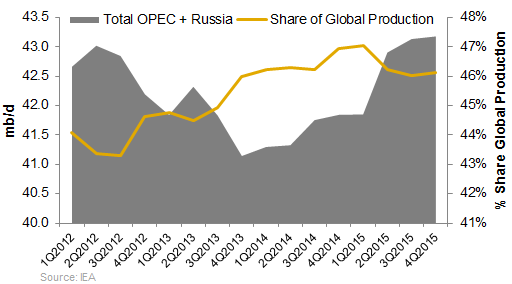 Total OPEC + Russia vs. Share of Global Production |
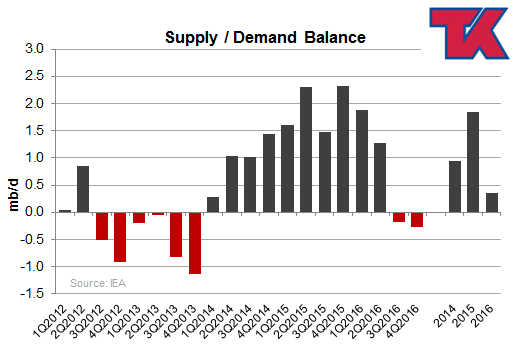 Teekay’s Supply / Demand Balance |